
Winter quarter started off with breakfast tables, welcome parties, and an unexpected guest: a Microsoft system outage.
Shoreline College had been planning to migrate all student emails and services from Google to Microsoft. Under Microsoft, email accounts would now be accessible through Outlook, and the email addresses would change from ‘go.shoreline.edu’ to ‘shoreline.edu’ This migration was slated to take place at the end of December, coinciding with the start of the winter quarter.
However, on Dec. 30, in the midst of the migration and just days before winter quarter started, Shoreline ran into an unexpected configuration error that left students and faculty without access to Microsoft programs. For a while, staff and students lost access to services on Outlook, such as Teams, Starfish, and perhaps most importantly, online support for Microsoft, which greatly impeded efforts for Tech Support Services (TSS) to resolve the issue. As a direct result of the outage, campus closed early on Dec. 30 and suspended operations on Dec. 31. Thankfully, services such as the rave alert system and the Parent Child Center were unaffected by the outage.
Students were mostly unable to access their email accounts, and could not communicate with professors, advisers and many other staff at Shoreline. This proved especially troublesome for incoming international students, as many of them were unable to contact their academic advisors. Contact with professors was also hampered, but students were able to find a way around this using Canvas’s messaging system, which was not affected by the outage.
For staff like Retention Specialist Elle Rivera, being locked out of Microsoft apps like Excel and Teams meant that a lot of work would be pushed back and not being able to communicate with students.
“I had…five or six students who came to see me because they couldn’t email anybody. They couldn’t call anybody,” said Rivera. “We’ve had students who are struggling to get the financial aid appeal…so they might have done their part and filled out the appeal and everything, but if they need a letter of support or something like that, it’s hard to reach people.”
While TSS worked to help resolve the outage, some people found many ways to work without access to Microsoft. Zoom filled the role of communications. Though unorthodox, it was still a viable method for staff and students to talk to each other. A Zoom Room fit that need, wherein students were able to join in should they need to talk to staff or have any queries.
Without access to Microsoft support through the college’s tenant account, TSS had to make do and contact Microsoft through other ways. Jason Brandon, director of TSS, and his team worked even outside of business hours getting in touch with Microsoft, or getting to people who could get them in touch with Microsoft.
“We reached out to Microsoft reps that we had. We reached out to our vendors that we purchased Microsoft through, and all of them were very helpful to get us to the right groups,” Brandon said. “Additionally, we reached out to our sister colleges to get our support tickets escalated.”
Shoreline’s executive team even used contacts and connections they had to Microsoft.
“We were trying to hit them from multiple angles. One of our board of trustee members is affiliated with Microsoft, and he was trying to help from his angles,” said Cat Chiappa, the college’s spokeswoman.
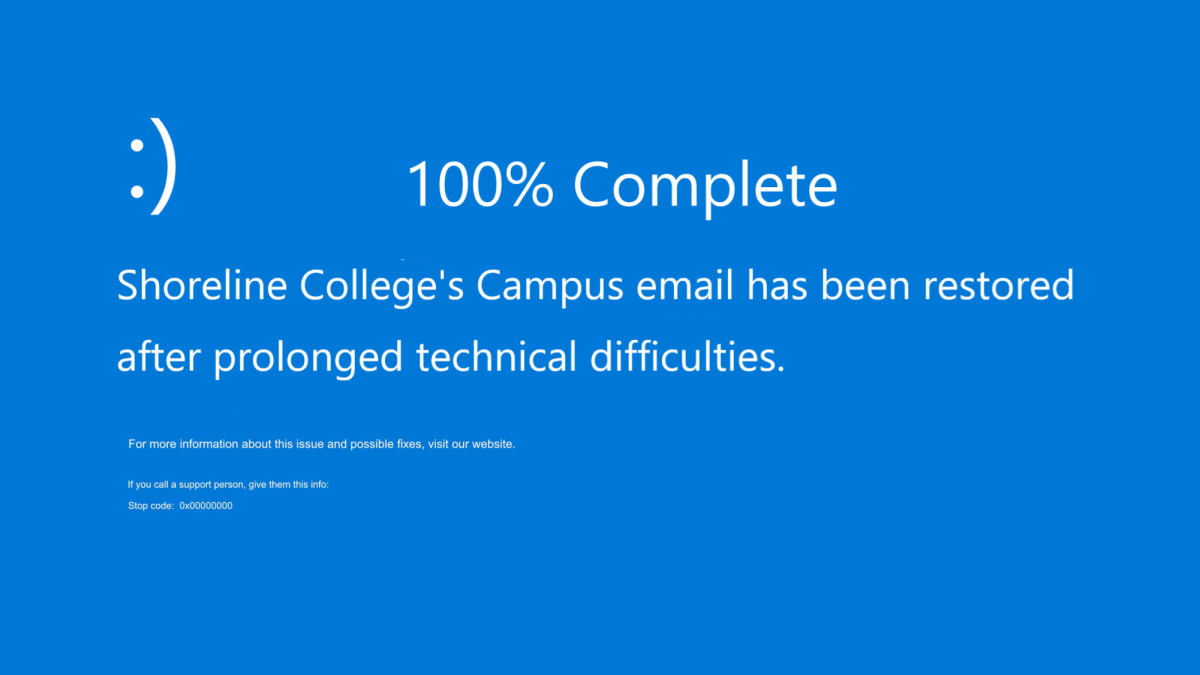
Eventually, the countless hours of work put in by the staff paid off: systems were restored on the afternoon of Jan. 6, thus ending the week-long outage. Emails were accessible again, and Starfish was back up. However, the staff still couldn’t rest easily. There was still a backlog of work that was pushed back from the outage, some of which had urgent deadlines. Nonetheless, with the restoration of system services, things could finally start getting back to normal.
“We’ve already displayed that we are willing to do whatever needs to be done to support our students, and that I have the utmost confidence in,” Brandon said. “However, going forward, I know that we are working hard to make sure we’re taking all the lessons from this, figure out what we did well, what didn’t go well… those are the things that’s important when things like this happen to make sure you don’t lose those lessons.”
Additional reporting by Johanna Wilder