
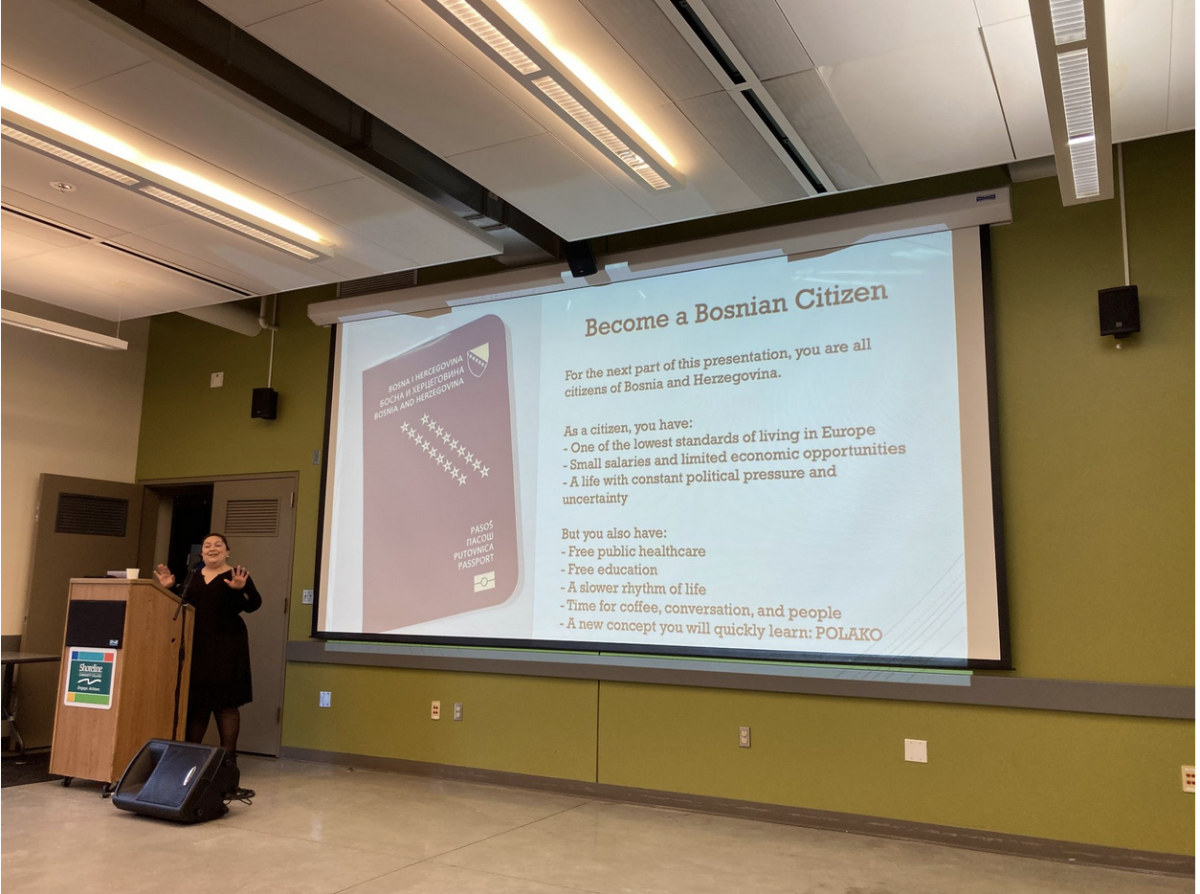
On April 21st from 5:30 – 6:30 p.m. Bojana Ilić gave a presentation on Bosnia and Herzegovina, which has one of the most complicated political and legal systems in the world with 5 Presidents sharing leadership, in PUB 9208, Small Dining Room at Shoreline College. She specializes in human rights and is a gender activist. She is a Visiting Hubert Humphrey Fellow in Washington DC.
Geopolitics of the country
Bosnia and Herzegovina have been ruled by many empires that influenced their culture and religion. Both countries used to be a part of Yugoslavia; until a civil war broke out with three different ethnic groups. The Dayton Peace Agreement, named after Dayton, Ohio, where the negotiations were held, brought an end to four years of war and resulted in a signed peace treaty. Bojana discussed the lives of the people after this peace treaty was signed. Americans have heard about Bosnia in the news during the war; however, she wanted to share the beauty of the country and a place to be considered for tourism.
Bojana explained this complex system in an interactive talk with the attendees and invited us to become citizens of Bosnia and Herzegovina. She mentioned that “living there is the lowest standard in Europe, and low salary and constant political pressure and free health insurance and free education. Always time for gatherings and for drinking coffee together.” The speaker introduced us to ‘Polako’. ‘Polako’ is a concept that means to slow down or take it easy, helping citizens navigate the everyday challenges of living in the country. The word ‘Ceif’ is part of ‘Polako’, meaning joyous pleasures from coffee to conversations. There is another word that is part of the concept called ‘Merak’, a bliss of a feeling when you are enjoying all five senses.
Bosnia doesn’t have a lot of coasts, but 12 kilometers (7.46 miles) of coast is majestic! Most of the country is made up of forests, mountains and villages and has few cities, and the biggest city, Sarajevo has 600K citizens. “Many young people are leaving the country in large numbers. Bosnia has many rivers, including seven major ones. Those places don’t have many tourists, but you can discover so many waterfalls, more waterfalls than Germany, Spain, and Portugal combined. We often face international corporations trying to intervene and build power plants. Many international corporations are trying to misuse water sources, which is another human rights issue.” the speaker said. When I asked about the wineries, she said that there are a lot of wineries in the Herzegovina region, and that they are well worth a visit.
Aftermath of the civil war
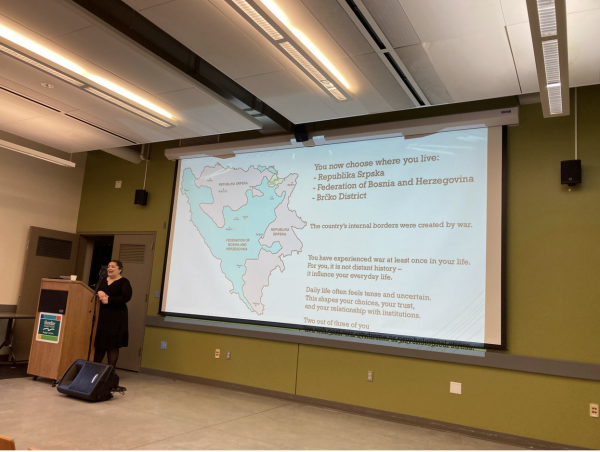
The borders of the country were created by war, and the two entities Republika Srpska and federation of Bosnia and Herzegovina. Additionally, there is the Brčko District, a self-governing entity. The entities have different governments, policies and rules. The citizens witnessed a war every 30-40 years. Daily life is full of uncertainty and a lot of political pressure. How do you survive in uncertainty? After the peace agreement, there was another war to survive in the new reality of the aftermath: every 2 out 3 people are suffering from Post-Traumatic Distress Syndrome(PTSD). The peak of the syndrome was 8 years after the war, where there were a dramatic number of citizens who committed suicide, and people could not live with the images of the war in their mind. They live in peace today, but they need to remind themselves that doing so requires extra effort. Bojana highlighted that the citizens want to join the European Union as it means peace in a longer-term period, and there is no conflict again.
There are many Bosnian refugees in America (and Australia) who cannot return home because the infrastructure cannot support them, or because they do not feel welcome or part of the community anymore. Refugees faced significant challenges finding employment and reclaiming their properties. During and after the war, the reality of mixed marriages became complicated. For example, a Bosnian Muslim mother and a Serbian Orthodox father married and had a son. The son was only six years old when the war broke out, making it unsafe for the father to stay in that region. It took the family four years to reunite, highlighting how many families were torn apart by the war.
Quagmire
The federation is split into small entities, each with its own government, laws, and institutions. Because of this, the elections you vote in directly shape your daily life, and people in neighboring cities can have very different experiences. Corruption is rampant and considered a part of daily life. It has become deeply embedded in the country’s culture. Bosnian citizens vote for three presidents. While the country has a larger presidential body, Bojana focused on these three for the scope of this presentation. Each of the three main ethnic groups has one president representing them. Also, there is a high representative. The High Representative is not a local citizen; rather, they represent the international community. The current High Representative is a German citizen who was appointed by the Peace Implementation Council, meaning the public cannot vote for him. Bojana jokingly said that “her friends often ask her how to become a High Representative for her country.”
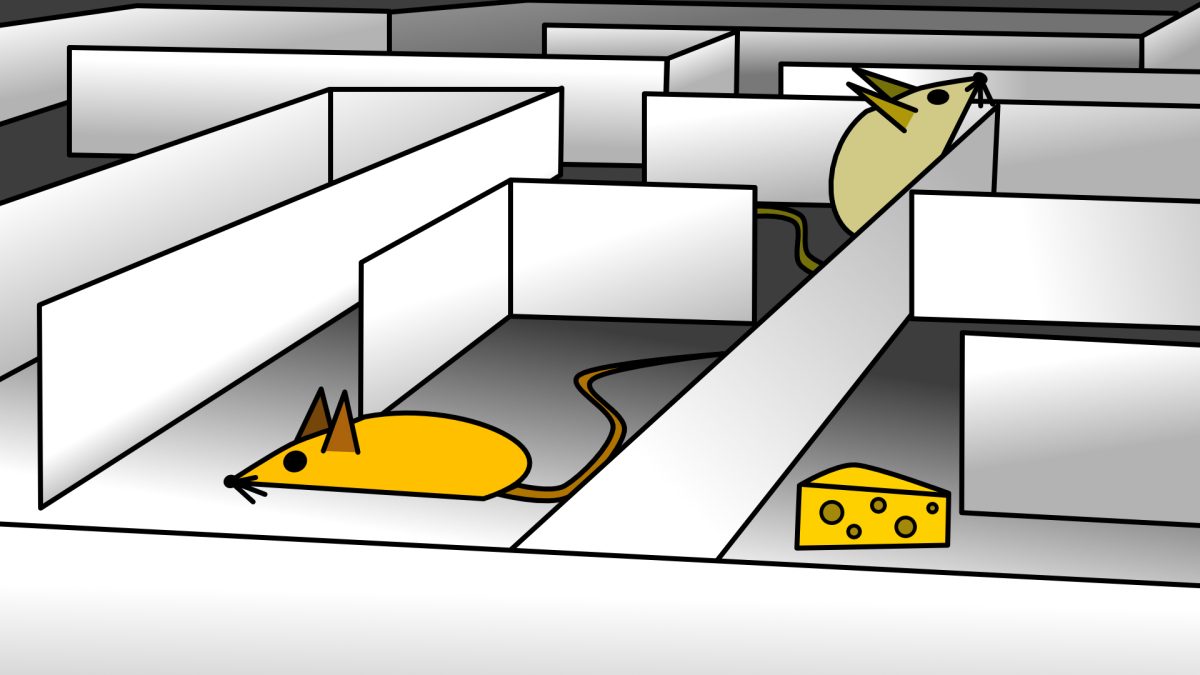
Aside from voting issues, the country faces significant economic challenges, including rising prices, unemployment rates reaching 20%, and failing infrastructure. While the railways and metro systems were severely damaged during the war, two new rail lines were eventually built. Unfortunately, the trains later collided with one another. The country seems unmanageable, the justice system is complicated as well, the constitutional court has 9 judges, the 4 of them are from the federation, 2 from the republic and 3 from the international community that are there to make sure all decisions are made fairly. All decisions are made according to human rights.
One instance of the complexity of daily life in Bosnia is the drastic financial disparity between regions. For example, a mother in one canton might receive $150 per year, while another mother living in a neighboring canton receives $20 per month, highlighting a system of immense discrimination. Furthermore, there is a constant legal conflict over whether federal laws or republic laws take precedence, making the system incredibly difficult to navigate.
In the same school, the Croatians and Serbians sit on different floors of the school, and each of them learns a different history from different books and authors. Although both groups of children spend time together, the laws do not allow the schools to merge. People are trying to unite children, but the politicians have obstructive policies. Fortunately, young people want to live together in one country, especially the youth of today. When I asked where mixed- ethnic children would go in the school system, she replied, “They had to pick one.” Concluding on a lighthearted note, Bojana shared an image of handmade traditional Christmas bread and advised, ‘Take everything Polako.’ She added, ‘History is painful for us and the things from the war are hard, but I want to concentrate on modern life in Bosnia and Herzegovina.