
We live in an attention economy. If time is money, then attention is cryptocurrency: non-fungible, fickle in its fluctuations, and only fleetingly focused. Our attention, like our money, doesn’t go as far as it used to.
You don’t find it ironic that the media apparatus that was built to commodify your attention led to what is colloquially known as “brain rot?” I sure do, but then, I’m a Gen X-er, and we find everything ironic. But let the record show that the harder we journalists work to get you focused on what we deem important, the harder you tune out.
Sure, it’s easy to blame it all on the evils of social media and surveillance capitalists. Yet, the attention deficit existed long before TikTok. There is a history here that goes back a long, long way.
Journalism’s most prestigious award, the Pulitzer Prize, is named after a guy who popularized sensationalism. Back then, it was called “yellow journalism” after “The Yellow Kid,” a character in a cartoon drawn by the artist who invented the word balloon so his readers wouldn’t get confused over who said what. The rot goes back, way back.
The Schrödinger Generation
Recently, Gallup asked Gen Z folk, “Does AI give you feels or nah?” The answer — as with all polling — is a resounding, “It depends.”
A good headline is worth its weight in gold, they say. It reaches out and grabs the reader’s attention, holds it firmly in a head lock, and doesn’t let go until the reader’s attention turns blue.
Your takeaway is going to be largely based on where you read about it. While Gallup’s headline is “Gen Z’s AI Adoption Steady, but Skepticism Climbs,” Axios’ headline reads, “Gen Z’s fading AI hype” or “Gen Z’s growing AI anger” depending on which search engine you use, and Forbes merely labels the article as, “Gen Z’s Relationship With AI.”
The survey data informs us that 52% of K-12 students think they’ll need to know how to use AI in their post-secondary schooling. How anxious and angry do you think they’ll feel when they make it to community colleges like Shoreline College, where faculty is either hoping the problem will go away and take the hype with it and/or struggling for ways to integrate it into lesson plans without support from administrators? This discrepancy leaves students without clear direction from the adults they’re looking to for guidance.
Journalists — who increasingly get paid by the click instead of by the word — get excited about polling and appeal to its scientific authority, “Researchers studied! Data suggests!” Sometimes we smuggle our own clever deductions into a news story. Like a cut of beef at the grocery store, these meaty reports are allowed to contain a certain amount of bullshit. It’s all fine and dandy as long as the consumer takes all the responsibility for cooking it properly.
But you wouldn’t know what’s beneath the bun from reading the headline. In the New York Times’ Style Section you would be informed that Gen Z is not feeling great about AI. In fact, reading further, you might get the impression they’re mad as hell, and not going to take it anymore.
Or, at least 31% of them are, and 42% aren’t exactly mad, merely anxious. But how differently would you feel if instead the article were titled, “49% of Gen Z curious about AI” which is equally as valid a conclusion as can be drawn from the very same polling.
By the end of the article, Gen Z has made a mighty rapid recovery from “not feeling great” to “curious” over the span of a handful of paragraphs. You wouldn’t appreciate the journey unless you took the time to read the whole article, and in an online culture that values short-form video content above all else, who has time for reading?
No wonder we’re all anxious. We live in a world of attention-driven bias. Everything is unfair and wrongs can only be righted by applying more unfairness. When the scales topple against us, we keep piling on in the name of justice. It’s only a matter of time before the scales themselves are crushed under the weight of it all.
But it wasn’t big tech who did this to us. We were not forced to consume this dreck, we produced it. We are all, as social change theory reminds us, complicit. Yes, big tech profited off of our obsessions, for they had little incentive to do otherwise, but the responsibility for our behavior lies with us. We all signed up to be a part of the public shouting matches because we thought we might win. Then like sore losers — and there are no winners in this game — we blamed the outcome on the guys who sold tickets to our public humiliation.
A New Hope
In his February article in The Atlantic on the disruption AI may or may not be wreaking, Josh Tyrangiel sums up every reporter’s predicament, “[Experts] are rarely equipped to give straight answers about the present. Journalists hate when the future won’t reveal itself on deadline.”
Read it, if only for the anthropological survey of cultural divides that are creating and created by the conflict of values at play. Yet Tyrangiel’s prescription is merely more of what Americans from all walks of life have been rejecting since 2016: educated elites making decisions for the rest of us based on inconclusive data and untrusted analyses.
Whether you’re for or against educated elites running the government or not, they are disempowered and in disarray. They are not coming to save us from AI, as most of them are too busy building it.
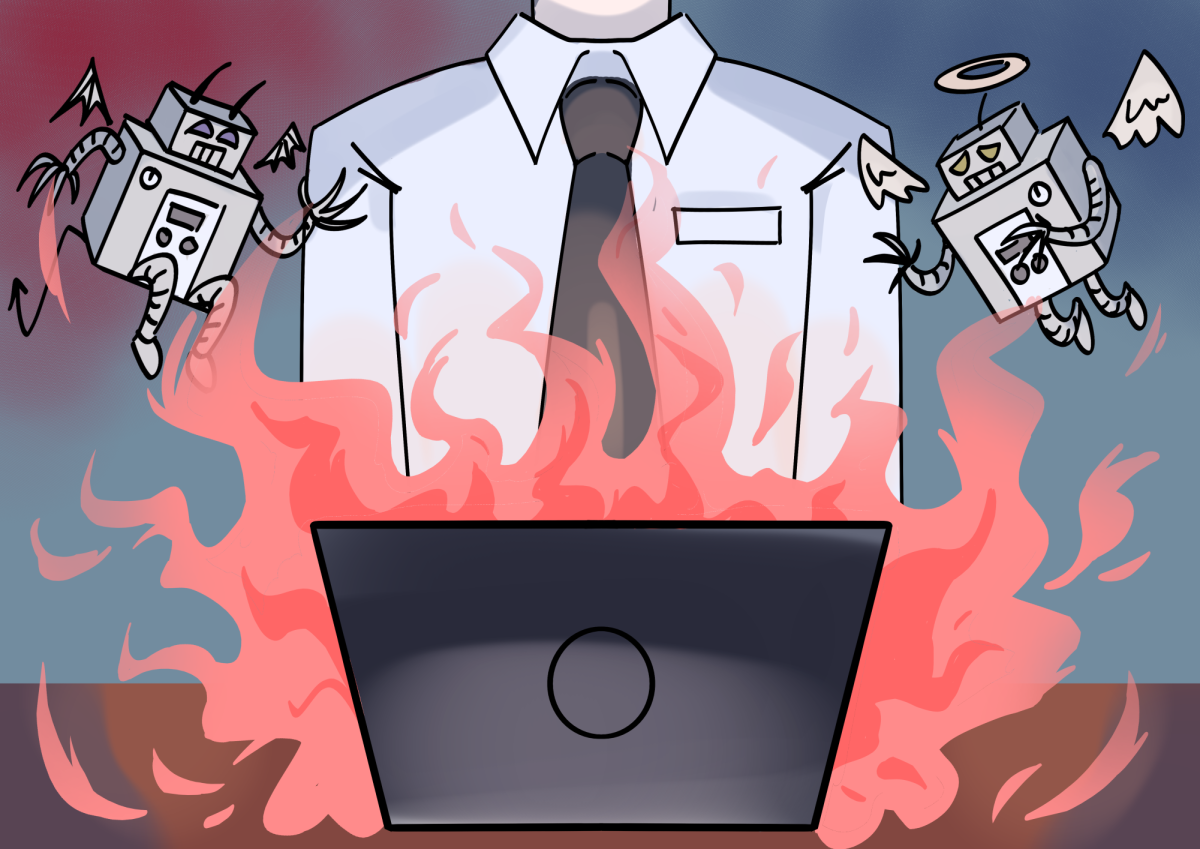
When interviewed on PBS NewsHour this past Friday, Tyrangiel said that for all of us, whether filled with hype, doubt, anger, anxiety, curiosity, or a healthy mixture of all five, “Sitting it out, waiting for regulation [isn’t an option]. You can’t duck and cover. This is actually a really important technological moment, and I would encourage everybody to start thinking about themselves in relation to A.I.,” he said.
Decades ago, I helped build and guide media products that young people in my classes today still enjoy, even though those products have since been co-opted from their original purpose. Today, I try to support young activists in taking their stand, even if their stands sometimes make me question if they’ve thought them through to their logical conclusions. I suppose we’re all guilty of that.
Activism can be — and historically has been — so much more challenging and provocative than clever sloganeering or blowing whistles at authority. Fighting change is rarely the solution because change itself is inevitable. In my generation, known for its punk rock anarchism, what kept us from cratering into nihilism was a vibrant DIY and remix culture that acted as a creative counterforce orthogonal to the monotone corporate blandness we were rejecting.
I’m not here to tell you how to do activism, other than to say that in my experience, effective activism isn’t about fighting so-called enemies, it’s about building community and empowering allies. And as Rev. Dr. Martin Luther King, Jr and Sailor Moon have both said, “the best way to defeat an enemy is to make them a friend.”
For the young generation raised on a diet of doubt and distrust, consider F. Scott Fitzgerald, who wrote in his essay, “The Crack-Up,” that the evidence of “first-rate intelligence” is holding two opposing ideas and improving upon them, rather than being forced into choosing one or the other. Yes, our future prospects are terrifying and yet also filled with transcendent potential. For the anxious who still struggle mightily to imagine a hopeful future, Fitzgerald’s appeal is as valid today as it ever was: to “be able to see that things are hopeless and yet be determined to make them otherwise.”
As Tyrangiel writes in his article warning about the effects of another kind of first-rate intelligence, “To understand how fast the present is hurtling us into the future, you need a fixed point, and the fixed points are all in the past.” In news articles — as with all things in life, including technological advances — the only sure path to a happy ending is to pay attention all the way through to the end.